The sunscreen market in India is growing as more consumers become aware of sun protection, premature skin ageing, tanning, pigmentation, and the effects of UVA and UVB exposure. For skincare businesses, this creates an opportunity to introduce sunscreens designed for different skin types, lifestyles, and customer preferences.
However, launching a sunscreen brand does not necessarily mean setting up your own manufacturing facility. Private label sunscreen manufacturing in India allows brands, startups, distributors, and cosmetic businesses to launch sunscreen products through an established manufacturing partner.
At Cremon Cosmetics, we work with businesses looking for sunscreen manufacturing solutions, including private label, third-party, OEM, and contract manufacturing requirements.
This guide explains how private label sunscreen manufacturing works, what brands should consider before choosing a manufacturer, different sunscreen formulations, packaging, quality considerations, and the steps involved in launching your own sunscreen range.
What Is Private Label Sunscreen Manufacturing?
Private label sunscreen manufacturing is a business model where a cosmetic manufacturer produces sunscreen products that another company sells under its own brand name.
Instead of investing in manufacturing machinery, formulation infrastructure, production staff, and an entire manufacturing facility, a brand can work with an experienced private label sunscreen manufacturer.
Depending on the project and manufacturer, private label services may include:
- Sunscreen formulation and product development
- Raw material sourcing
- Bulk manufacturing
- Filling and packaging
- Label and packaging support
- Quality control and product testing
- Custom formulation options
- OEM and third-party manufacturing
This approach can be particularly useful for skincare startups and established cosmetic companies that want to expand their sunscreen range without developing a complete production facility themselves.
Why Are Brands Choosing Private Label Sunscreen Manufacturing in India?
India has a large cosmetics and personal care manufacturing ecosystem. Private label manufacturing gives businesses access to manufacturing capabilities while allowing them to focus more heavily on branding, distribution, sales, and marketing.
Lower Initial Manufacturing Investment
Establishing a sunscreen manufacturing facility requires machinery, trained personnel, raw materials, quality-control systems, storage facilities, and other infrastructure.
With private label sunscreen manufacturing, brands can outsource production rather than building all of this infrastructure independently.
Faster Product Development
Working with an established manufacturer can simplify several stages of product development.
Depending on the project, brands may be able to choose from existing sunscreen bases or discuss customized formulations according to their target market.
Opportunity to Build Your Own Brand
The finished sunscreen can be marketed under the client’s own branding and packaging, subject to applicable labeling and regulatory requirements.
This makes private label manufacturing suitable for:
- New skincare brands
- Cosmetic companies
- Beauty businesses
- Distributors
- Retail businesses
- E-commerce brands
- Exporters
- Dermatology-focused brands
Ability to Expand the Product Range
A business does not have to limit itself to one sunscreen format.
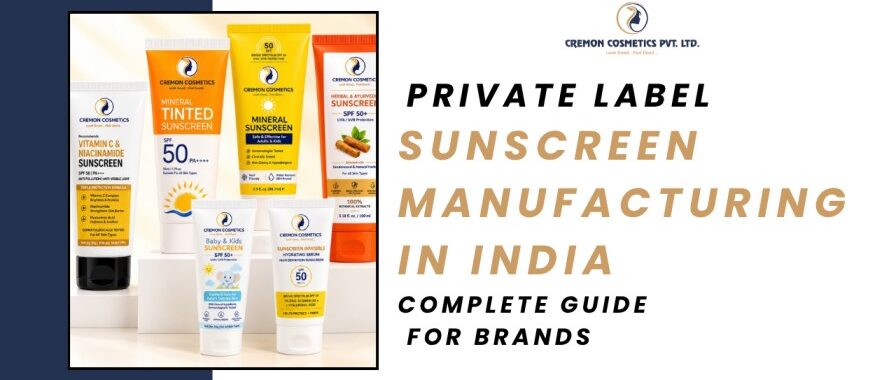
As demand develops, brands can consider additional products such as mineral sunscreen, tinted sunscreen, sunscreen gel, SPF 50 sunscreen, baby sunscreen, or sunscreen enriched with skincare ingredients.
Types of Sunscreen Products Brands Can Consider
One of the most important decisions when launching a sunscreen is deciding what type of formulation fits your target customer.
Here are some common options.
Mineral Sunscreen
Mineral sunscreens commonly use mineral UV filters such as zinc oxide and/or titanium dioxide, depending on the formulation.
Brands interested in mineral-focused skincare ranges can explore factors such as texture, finish, skin feel, compatibility with other ingredients, and target SPF.
Tinted Sunscreen
Tinted sunscreen combines sun-protection positioning with a tinted cosmetic finish.
It can be particularly relevant for brands targeting customers who want sunscreen that fits easily into a daily skincare or makeup routine.
When developing a tinted sunscreen, shade selection and finish are important considerations alongside sun-protection performance.
SPF 50 and SPF 50+ Sunscreen
High-SPF products are a major category within modern sunscreen ranges.
However, an SPF claim should not simply be selected for marketing purposes. The formulation and finished product need appropriate testing to substantiate the claimed level of protection.
Sunscreen Gel
A sunscreen gel can appeal to consumers looking for a lighter texture, particularly in hot and humid climates.
Brands can discuss characteristics such as:
- Lightweight feel
- Quick absorption
- Non-greasy finish
- Skin compatibility
- Texture and spreadability
The exact claims should always reflect the final tested formulation.
Herbal or Ayurvedic-Inspired Sunscreen
Some brands prefer sunscreen products positioned around botanical or traditional skincare ingredients.
Depending on the formulation concept, botanical ingredients can be incorporated alongside an appropriate UV-protection system.
Brands should avoid assuming that a botanical ingredient alone provides the claimed SPF. Sun-protection claims need to be supported appropriately.
Baby & Kids Sunscreen
Sunscreen intended for babies or children requires particularly careful formulation, ingredient selection, testing, claims, and labeling.
A manufacturer should understand the intended age group and use case before developing this category.
Sunscreen With Skincare Actives
Modern consumers often expect more than a basic sunscreen.
Depending on formulation compatibility, brands may explore ingredients commonly associated with skincare, such as:
- Niacinamide
- Vitamin C derivatives
- Hyaluronic acid
- Vitamin E
- Botanical extracts
- Moisturizing ingredients
This allows brands to develop products positioned around sun protection plus complementary skincare benefits, where those benefits can be appropriately supported.
How Does Private Label Sunscreen Manufacturing Work?
Although the exact process varies between manufacturers and projects, private label sunscreen development generally follows several stages.
1. Understanding the Brand Requirement
The process begins with defining what the brand wants to launch.
Important considerations include the intended:
- Product type
- Target audience
- SPF positioning
- Texture
- Finish
- Ingredients
- Packaging
- Quantity
- Price positioning
- Target market
A clear product brief helps reduce unnecessary formulation changes later.
2. Selecting or Developing the Formulation
The next stage is deciding whether an existing suitable formulation can be used or whether a custom sunscreen formulation is required.
For example, a brand may request an SPF 50 sunscreen with a lightweight finish, while another may want a tinted mineral sunscreen aimed at everyday use.
3. Sampling and Evaluation
Before bulk production, samples may be developed for evaluation.
The brand can assess relevant characteristics such as appearance, fragrance where applicable, consistency, spread ability, absorption, skin feel, and overall product experience.
Necessary changes can then be discussed before proceeding further.
4. Testing and Quality Evaluation
Sunscreen is a technically demanding skincare category because its key performance claims relate directly to UV protection.
Depending on the formulation, intended claims, market, and applicable requirements, relevant testing and evaluation may include areas such as SPF performance, UVA protection, stability, microbiological quality, and other product-specific parameters.
The appropriate testing program should be determined for the actual product rather than assumed from a generic formulation.
5. Packaging Selection
Packaging affects both product presentation and usability.
Common sunscreen packaging options can include tubes, bottles, pumps, and other compatible cosmetic packaging formats.
Brands should consider:
- Product compatibility
- Ease of dispensing
- Leakage resistance
- Size
- Branding area
- Transport durability
- Overall customer experience
6. Bulk Sunscreen Manufacturing
Once the product specifications and required approvals are finalized, the formulation can move into bulk production.
A controlled manufacturing process is important for maintaining consistency between batches.
7. Filling, Packing and Final Inspection
The sunscreen is filled into the selected packaging, followed by the applicable packing and quality checks.
The finished goods can then proceed according to the agreed supply and dispatch process.
Private Label vs Third-Party vs OEM Sunscreen Manufacturing
These terms are often used together, but their meaning can vary between suppliers.
Private Label Sunscreen Manufacturing
The manufacturer produces the sunscreen while another business markets the finished product under its own brand.
This can be useful for companies that want to concentrate on building their brand rather than operating a manufacturing facility.
Third-Party Sunscreen Manufacturing
Third-party manufacturing generally refers to outsourcing manufacturing to another company.
The brand owns or markets the product while production is handled by the manufacturing partner under the agreed arrangement.
OEM Sunscreen Manufacturing
OEM, or Original Equipment Manufacturer, arrangements can involve producing products according to a client’s defined requirements.
Depending on the project, this may include customized formulation, specifications, packaging, or other product-development requirements.
Because manufacturers may use these terms somewhat differently, brands should confirm exactly what services are included in the quotation and manufacturing agreement.
How to Choose a Private Label Sunscreen Manufacturer in India
Choosing the right manufacturing partner can affect product quality, scalability, compliance, and ultimately your brand reputation.
Check Manufacturing Capabilities
Find out whether the manufacturer has suitable equipment and processes for the sunscreen formats you want to produce.
A manufacturer experienced in creams may not necessarily have the same capabilities for every specialized sunscreen formulation.
Ask About Quality-Control Procedures
Ask how raw materials, manufacturing batches, filling, and finished products are evaluated.
Quality should be considered throughout the manufacturing process rather than only after the product has been packed.
Discuss Sunscreen Testing
This is especially important.
Ask what testing is appropriate for your formulation and claims, who performs it, and what documentation is available.
Do not choose a sunscreen manufacturer based only on a low quotation.
Understand Customization Options
If your goal is to differentiate your brand, discuss how much customization is actually available.
You may want to customize elements such as texture, active ingredients, fragrance where appropriate, packaging, product positioning, or other formulation characteristics.
Discuss Minimum Order Quantity
MOQ can be especially important for startups.
Ask about minimum production quantities for the formulation and packaging you are considering, because packaging suppliers and custom components may have separate minimum quantities.
Evaluate Scalability
Your initial order may be relatively small, but successful brands need reliable manufacturing as sales increase.
Ask whether the manufacturer can support larger future production volumes while maintaining consistency.
Important Things to Decide Before Launching Your Sunscreen Brand
Before contacting a manufacturer, it helps to create a simple product brief.
You should ideally know:
Who is your customer?
Are you targeting teenagers, adults, children, premium skincare customers, mass-market consumers, or another specific segment?
What problem are you addressing?
For example, your positioning may focus on lightweight everyday wear, a tinted finish, hydration, or another clearly defined consumer need.
What sunscreen format do you want?
Decide whether you are interested in a cream, lotion, gel, serum-style sunscreen, mineral formulation, tinted sunscreen, or another format.
What SPF positioning do you want to explore?
Discuss the intended protection level with the manufacturer and ensure final claims are based on appropriate testing.
What is your target price?
Your target retail price affects formulation, packaging, positioning, and production decisions.
Common Mistakes New Sunscreen Brands Should Avoid
A common mistake is choosing a product only because it is inexpensive to manufacture. Sunscreen is a performance-driven category, so formulation quality and appropriate testing should receive serious attention.
Another mistake is trying to add too many actives and marketing claims to one formula. A long ingredient list does not automatically create a better product.
Brands should also avoid copying competitors too closely. Successful private label development should still have a clear target customer and positioning.
Finally, packaging should not be selected purely for appearance. It needs to work reliably with the actual formulation.
Why Work With Cremon Cosmetics for Sunscreen Manufacturing?
Cremon Cosmetics supports businesses looking to develop and manufacture sunscreen products in India through private label, third-party, OEM, and contract manufacturing solutions.
Brands can discuss different sunscreen concepts, formulations, packaging requirements, quantities, and product positioning according to their business needs.
Whether you are planning to introduce a mineral sunscreen, tinted sunscreen, SPF 50 sunscreen, herbal sunscreen, baby sunscreen, sunscreen gel, or skincare-active sunscreen, the development process should begin with a clear understanding of your target market and product requirements.
For businesses researching production partners, you can also explore Cremon Cosmetics’ Sunscreen Manufacturers in India page for information about its sunscreen manufacturing services.
Frequently Asked Questions About Private Label Sunscreen Manufacturing
What is private label sunscreen manufacturing?
Private label sunscreen manufacturing allows a business to source sunscreen products from a manufacturer and market the finished products under its own brand, subject to the agreed formulation, packaging, labeling, and manufacturing arrangement.
Can I launch sunscreen under my own brand in India?
Yes. Businesses can work with cosmetic manufacturers to develop and manufacture sunscreen products for their own brands. The product, manufacturing, labeling, claims, testing, and other requirements should comply with applicable regulations.
Can sunscreen formulations be customized?
Customization depends on the manufacturer’s capabilities and project requirements. Brands may discuss ingredients, texture, finish, sunscreen format, packaging, and other formulation characteristics.
What is the minimum order quantity for private label sunscreen?
There is no single industry-wide MOQ. It varies according to the manufacturer, formulation, packaging, customization, and production requirements. Brands should confirm the current MOQ directly with their manufacturing partner.
Can I manufacture SPF 50 sunscreen under my brand?
A manufacturer can develop products intended for high-SPF positioning, but the final SPF and related protection claims should be supported by appropriate testing of the relevant formulation.
What types of sunscreen can private label brands launch?
Depending on manufacturing capabilities, options can include mineral sunscreen, tinted sunscreen, sunscreen gel, lotion or cream formulations, baby and kids sunscreen, herbal or botanical-positioned products, and sunscreens incorporating compatible skincare ingredients.
Final Thoughts
Private label sunscreen manufacturing in India can provide skincare businesses with a practical route to enter or expand within the sun-care market without establishing an entire manufacturing operation themselves.
The most important step is not simply finding a supplier that can fill sunscreen into a tube. Brands should look for a manufacturing partner that can understand the product concept, discuss suitable formulations, support appropriate quality and testing requirements, and scale production as the business grows.
With clear positioning, suitable formulation development, thoughtful packaging, appropriate testing, and a reliable manufacturing partner such as Cremon Cosmetics, businesses can build a sunscreen range designed around their target market and long-term brand strategy.